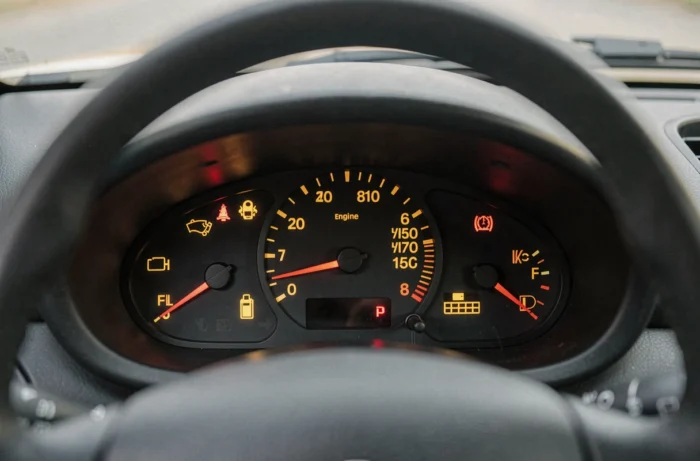
The Peugeot 206 remains one of the most common city cars on French roads, with record production for the lion brand. Its dashboard displays about fifteen warning lights, the meaning of which varies depending on the engine type (petrol, diesel, HDi with particulate filter) and the level of equipment. Confusing a simple maintenance reminder with a serious engine alert can turn a minor issue into a hefty bill.
OBD Diagnosis and Limitations of Generic Readers on the 206
Connecting a diagnostic tool to the OBD port of the 206 seems like the logical reflex when a warning light comes on. A generic OBD reader costing a few dozen euros does indeed read engine fault codes (P0xxx, P1xxx) and helps understand why the orange engine light remains on.
The problem arises with other systems. A generic OBD reader does not communicate with the airbag control unit (SRS) nor, on certain versions, with the ABS control unit. For these warning lights, only a tool compatible with the Peugeot protocol (or a high-end multi-brand diagnostic tool) can access the stored faults. The connectors under the seats, linked to the seatbelt pretensioners, are part of the pyrotechnic circuit: handling them without training exposes one to accidental deployment.
Knowing the list of warning lights on the 206 dashboard helps identify which control unit to query before heading to the workshop, and avoids paying for an unnecessary diagnosis on the wrong system.

Orange Engine Light on 206 Diesel: DPF, Sensor, or Improper Use
On the 206 HDi equipped with a particulate filter, the orange pollution warning light regularly causes concern. The first hypothesis, often circulated online, points to a clogged DPF that needs replacing. The reality is more nuanced.
A predominantly urban use prevents the regeneration of the particulate filter. This process requires a high exhaust temperature, achieved during prolonged highway trips. On routes of just a few kilometers, the regeneration does not complete, soot accumulates, and the warning light eventually comes on.
Before considering DPF replacement, several elements must be checked:
- The differential pressure sensor, which measures the clogging of the filter and can give erroneous values if it is dirty or faulty
- The EGR valve, whose malfunction increases the amount of soot sent to the filter
- The level of Eolys additive (on versions equipped with it), whose absence prevents any automatic regeneration
Reading real-time data via an appropriate diagnostic tool (differential pressure, exhaust temperature before and after DPF) allows distinguishing a truly saturated filter from a faulty sensor. Replacing a DPF without having checked these parameters amounts to treating a symptom, not the cause.
Intermittent Warning Light on Peugeot 206: Why Turning Off Does Not Mean Repair
A warning light that disappears after a restart can be misleadingly reassuring. The light goes off because the triggering conditions are no longer met at that moment, not because the fault has ceased to exist.
The fault code remains stored in the relevant control unit. It will reappear as soon as the same conditions occur: temperature rise, hard acceleration, prolonged driving. This behavior is common with the oil pressure light (which may come on when hot at idle and then turn off while driving) or the ABS light (which appears in cold weather and then disappears).
What to Note to Aid Diagnosis
The mechanic needs contextual information that the diagnostic tool does not always provide. Noting these elements at the moment the warning light appears changes the quality of the diagnosis:
- Was the engine cold or at operating temperature
- Did the warning light come on during acceleration, braking, or at idle
- How long after did the light disappear, or after what type of maneuver
- Did other warning lights come on simultaneously (the STOP light often accompanies an oil pressure or coolant temperature fault)
A coolant temperature warning light that briefly comes on while going uphill and then goes off while going downhill, for example, may indicate a fluid level just below the sensor threshold, a worn probe, or the beginnings of a failing head gasket. The context of appearance points towards the right track much more than the simple fault code.

Version and Engine Type: The Paper Manual Remains the Reliable Reference
Online guides often compile warning lights from several generations of Peugeot in a single article. The 206 was produced over a long period, with dashboard evolutions depending on the phases and trims. A warning light present on a 2004 206 2.0 HDi may be absent from a 1999 206 1.1 petrol.
The vehicle manual, originally supplied in the glove compartment, remains the most reliable document for identifying a specific warning light. It details each symbol with its exact location on the instrument cluster and the expected behavior (steady, flashing, accompanied or not by a buzzer). Cross-referencing the symbol with the manual for its specific version avoids misinterpretation.
For used vehicles whose manual has disappeared, Peugeot has made the technical documents for its older models available online. Specialized 206 forums also share scans of manuals by phase and engine type, allowing one to find the correct reference without resorting to a generic list.
A misidentified warning light leads to a poorly directed diagnosis, and then to unnecessary repairs. On a vehicle whose value remains modest, every intervention counts in the equation between reasonable maintenance and disproportionate expense.