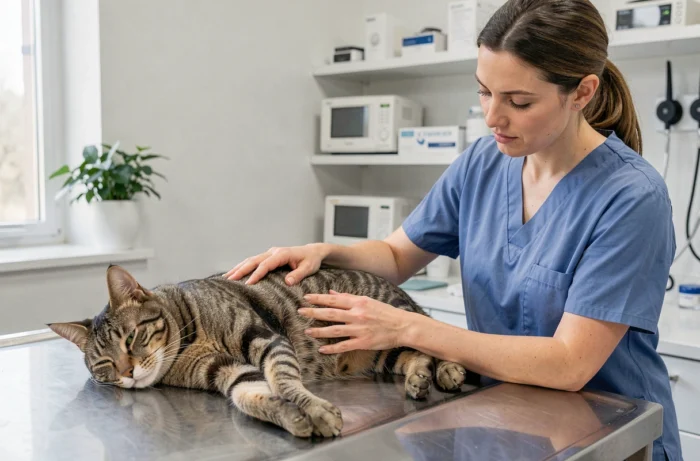
Neutering a cat represents a budget that many owners discover at the time of the first estimate. Veterinary fees are freely set in France, without a national pricing grid imposed. Depending on the sex of the animal, the chosen clinic, and the region, the bill can vary from simple to triple for a procedure that sometimes bears the same name.
What the estimate really includes behind the sterilization price
A sterilization fee does not compensate for a single act. It covers a series of medical procedures, the details of which vary from one clinic to another, making comparisons misleading if one limits oneself to the final amount.
The most significant cost is general anesthesia. It requires a protocol tailored to the weight and health status of the cat, monitoring during the operation, and observation upon waking. In addition, sterile surgical equipment, the veterinarian’s time, and often that of an assistant are included.
The pre-anesthetic assessment can significantly affect the bill. A clinical examination is generally scheduled before the procedure. For an older cat or one with a medical history, additional blood tests may be added. Their inclusion in the package is not uniform: some clinics include them, while others charge separately. Checking this point before signing the estimate helps avoid surprises.
The price difference between males and females is explained by the nature of the procedure. Castration of a male cat remains a short and minimally invasive operation. In females, the surgery is abdominal and longer. To delve deeper into this topic, the information on X Anima details the structural reasons for this gap.
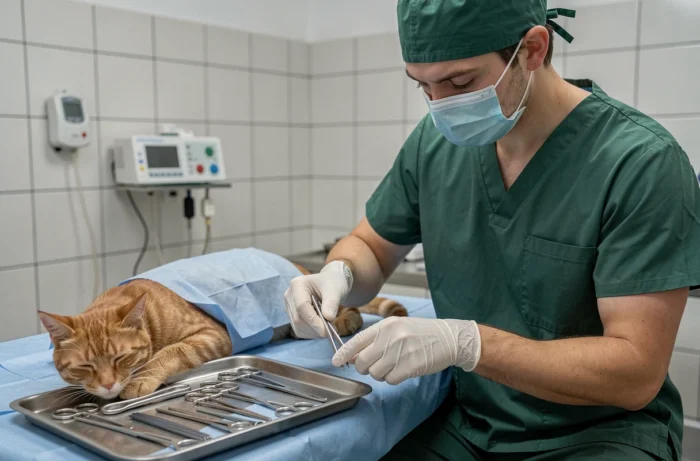
Ovariectomy or ovariohysterectomy: two procedures, two bills
One element that most price comparisons overlook: not all estimates for sterilizing a female cat describe the same operation. Two surgical techniques coexist, and their costs differ.
- Ovariectomy involves removing only the ovaries. It is the most common method in France, considered safe and sufficient to eliminate heat cycles and the risk of pregnancy.
- Ovariohysterectomy involves the removal of both the ovaries and the uterus. More complex, it is sometimes preferred for medical reasons (existing or suspected uterine infection).
- Chemical sterilization, through regular hormonal injections, has a lower unit cost. It remains temporary and can lead to sometimes serious side effects, making it not recommended for the long term.
Asking for the exact name of the planned procedure and what the package includes (post-operative pain relief, follow-up consultation, absorbable sutures, or suture removal) allows for comparing estimates on a truly equivalent basis.
Free veterinary fees: why prices vary so much from one clinic to another
In France, the fees for veterinary procedures are not regulated by any official scale. Each clinic sets its prices based on its expenses: rent, equipment, payroll, cost of consumables.
Geographic location plays a direct role. A clinic in the city center of a large urban area bears real estate costs unrelated to those of a rural practice. The technical platform also matters: a facility equipped with advanced anesthetic monitoring or performing laparoscopy passes this investment onto its fees.
The castration of a male generally ranges between 60 and 100 euros, while the sterilization of a female costs significantly more due to the surgical complexity. These discrepancies also reflect the disparity in operating costs from one clinic to another.
A low price does not necessarily indicate a degraded service, and a high price does not guarantee superior follow-up. What matters is knowing what the amount covers: gas or injectable anesthesia, pain relief included or extra, post-operative consultation included or billed separately.
Combining procedures to reduce the overall bill
Microchipping can be done during the same anesthesia as the sterilization. If the cat is not yet microchipped, requesting this combination avoids a second restraint and a second sedation. The cost of the chip and its registration may be included in a package or billed separately depending on the clinic.

Financial assistance and municipal programs for cat sterilization
The cost of sterilization deters some owners, but several programs allow for reducing the expense, or even eliminating it in some cases.
SPCA dispensaries and other associations offer sterilizations at reduced rates for owners with modest incomes. Access conditions vary depending on the structures and available spots.
For cats living in groups outdoors, the approach may fall under a municipal program rather than an individual expense. Some municipalities fund campaigns for sterilizing stray cats, regulated by legislation on wandering animals. The mayor can authorize the capture, sterilization, and release of identified feline colonies within the municipal territory.
- Inquire with the town hall about the existence of a stray cat sterilization program in the municipality.
- Contact SPCA dispensaries or local animal protection associations to learn about access conditions for reduced rates.
- Check if your pet health insurance provides a prevention package covering all or part of the sterilization, as some plans reimburse part of the procedure.
Sterilization remains, proportionally, a moderate investment compared to the veterinary costs incurred by preventable conditions. In females, the absence of sterilization is correlated with a high risk of mammary tumors or uterine infections, the treatment of which far exceeds the cost of a preventive ovariectomy. The price of sterilization is also measured against what it prevents.