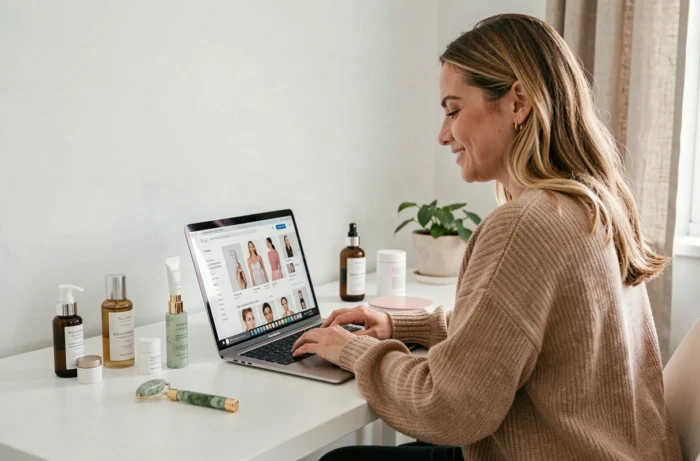
The online cosmetics market is worth several hundred billion euros globally, with steady annual growth. In France, more than half of beauty product buyers now use a website or mobile app.
This migration to digital is accompanied by a proliferation of brands, marketplaces, and specialized resellers, making sorting through options more complex than it seems. Between third-party sellers on major platforms, independent shops, and traditional brands digitizing their catalogs, the usual markers of physical commerce are no longer sufficient.
Third-party seller or direct brand: a distinction that changes your rights
On a marketplace, the name displayed at the top of the page is not always the one shipping the product. The mention “sold by” refers to the actual seller, and it is they who assume product compliance and legal warranty. The platform, in turn, must inform the buyer about the identity and status of this seller.
This nuance has direct consequences. A professional seller and a private seller do not offer the same protections: the right of withdrawal, compliance warranty, and recourse in case of disputes only fully apply to purchases from a professional. Before finalizing a cart, checking this status can prevent unpleasant surprises, especially when the displayed price seems unusually low.
For cosmetics, the European regulation on general product safety requires that online offers display information allowing for the identification of the product, its manufacturer, and applicable safety warnings. These requirements align with the specific regulation for cosmetic products without replacing it. A reliable site clearly displays the INCI list, country of manufacture, and contact details of the market authorization holder.
Catalogs that group verified brands facilitate this verification process. By visiting the site www sos-beaute com, one can access a selection of online shops whose seller and product information is already structured, reducing the time spent cross-referencing regulatory data.
Reliability of an online beauty site: criteria to check before paying
The reputation of a brand does not guarantee that every product listed on its site is authentic, especially when it opens its platform to external sellers. A few quick checks can filter out reliable addresses.
- The product page mentions the batch number, minimum durability date (or PAO, period after opening), and the complete list of ingredients. The absence of an INCI list is an immediate red flag.
- The general terms and conditions specify the legal identity of the seller (company name, SIRET number or European equivalent, physical address). A simple contact form without these mentions is not sufficient.
- The site offers a right of withdrawal in accordance with the legislation (generally fourteen days for a purchase from a professional), with a clearly described return procedure.
- Shipping costs are displayed before the payment step. A product offered at a reduced price can lose all its advantage if the shipping fees absorb the difference.
These points may seem basic, but a significant number of cosmetic resale sites omit at least one of them. Cross-checking these criteria takes less than two minutes and filters out the majority of unscrupulous sellers.
Online cosmetic counterfeiting: spotting concrete signs
Counterfeit cosmetics pose not only a perceived quality issue. A product whose formulation has not been tested according to European standards may contain banned or poorly dosed substances, posing real skin risks. Online, the lack of physical contact with the product makes detection more difficult, but some signs remain exploitable.
A packaging photographed with poor resolution or without a close-up view of the barcode deserves suspicion. Legitimate sellers have no reason to hide these details. Similarly, a price significantly lower than the price observed at authorized brand distributors often signals a diverted or counterfeit product.
The consistency of the offered range also matters. A reseller displaying both luxury brands and unbranded products without a logical assortment is likely operating on opportunistic sourcing. Serious specialized shops build a coherent catalog with traceable distribution partnerships.
The case of low-cost perfumes
Perfumes represent the category most affected by online counterfeiting. Price discrepancies between platforms can reach several dozen euros for the same bottle, encouraging the search for the cheapest offer. A perfume sold well below the manufacturer’s suggested retail price, without mentioning a dated promotional operation, should be questioned. Checking that the seller is listed among the brand’s authorized distributors remains the safest means.

Comparing the real cost of an online beauty cart
The price displayed on the product sheet does not always reflect the final cost. Three variables regularly distort comparisons between sites.
Shipping costs are the first invisible item. Some brands offer free shipping from a certain order amount, while others apply a fixed fee. On a purchase of a few euros (a lipstick, a sample), these costs can represent a significant portion of the total.
The product size is the second trap. A face cream displayed at a reduced price in a travel size of 30 ml often costs more per milliliter than the same product in standard size. Relating the price to volume or weight allows for comparing truly equivalent offers.
The third point concerns conditional promotions. Limited-time promo codes, flash sales, or offers reserved for new customers create a bait price that will not be repeated on the next order. Evaluating a site based on its price outside of promotions gives a more reliable picture of its pricing positioning.
Buying cosmetics online with confidence relies less on choosing a well-known brand than on checking a few structural points: seller identity, regulatory compliance of the product, transparency about the total cost. These reflexes, applied systematically, reduce risks much more effectively than a simple price comparison.