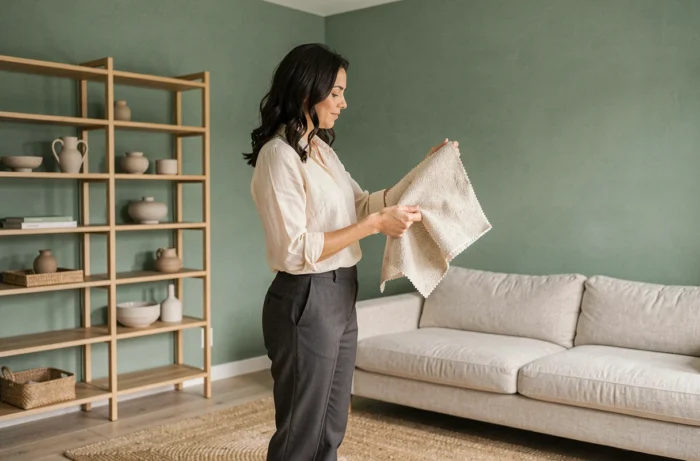
Decorating an interior is not about reproducing a magazine photo. It’s about assembling concrete choices (colors, furniture, materials) to create a space that works daily and reflects your tastes. The problem is that sources of inspiration are everywhere, and we often end up accumulating ideas without knowing how to translate them into our homes.
Air Quality and Interior Decoration: The Invisible Criterion
Have you ever noticed a persistent smell after repainting a room? These are volatile organic compounds, the famous VOCs. In France, paints and decoration products intended for indoor use carry a VOC emission label ranging from A+ to C. A+ indicates a very low emission level, while C indicates a high level.
This classification changes the way you choose paint. For a bedroom or a poorly ventilated room, opting for a product rated A+ is not a luxury; it’s a health precaution. Color remains the main criterion, of course, but two identical shades from two manufacturers can have very different emission levels.
Before buying, turn the pot around. The label is on the packaging. If you order online, look for this information in the product sheet. For a living room or an open kitchen, natural ventilation partially compensates, but in a studio or compact apartment, the VOC rating becomes a real selection criterion.
This reflex also applies to glues, varnishes, and wall coverings. Interior design is not limited to appearance: it includes what you breathe.
To deepen your layout projects, you can discover the home section on Pop Shot, which regularly addresses these topics from a practical angle.
Colors and Living Room Layout: Start from the Floor, Not the Wall
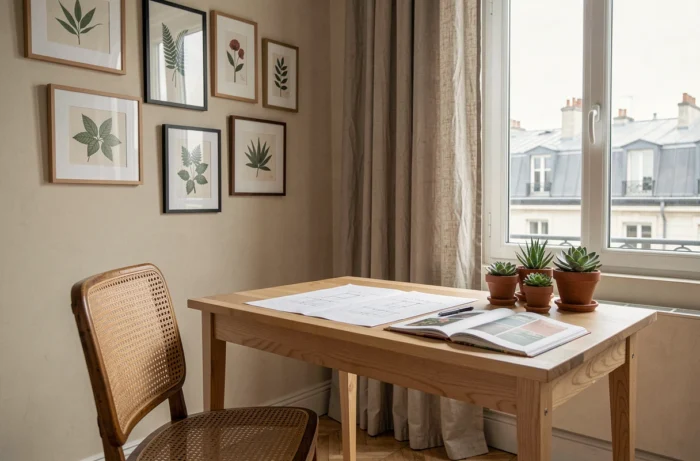
The classic mistake is to choose the wall color first. The floor is, however, the most difficult (and expensive) element to replace. If you have light oak flooring, anthracite gray tiles, or polished concrete, it’s this base that should guide the palette.
A dark floor supports light walls and warm-toned furniture. A light floor offers more freedom, but be careful of overly uniform combinations that flatten the space. The contrast between the floor and furniture visually structures the room.
For the living room, the space where we spend the most awake time, ask yourself this question: what usage dominates? If it’s reading and resting, muted tones (terracotta, sage green, muted blue) promote relaxation. If it’s a reception area, brighter colors on a wall or an accent piece of furniture create a focal point.
Test Before Committing
Paint testers exist for a reason. Apply a sample to a surface of at least thirty square centimeters, then observe it at different times of the day. Natural morning light and evening artificial lighting radically change the perception of a shade.
A gray that appears soft in the store can turn mauve under cold LED lighting. Always test the color in the relevant room, not in the store’s hallway.
Second-Hand Furniture and Material Reuse: Beyond the Trend
The second-hand market for furniture and decoration has significantly progressed in recent years in France. Hunting for a vintage sideboard or reclaiming old tiles gives a unique character to an interior. But reusing a material is not just about finding a beautiful piece.
Recovered elements (beams, tiles, bricks) may require checks for strength and compatibility with their new use. A decorative exposed beam does not have the same constraints as a load-bearing beam. An old cement tile may be porous and unsuitable for a bathroom without prior treatment.
Here are the points to check before integrating a reused element:
- Structural condition: cracks, signs of moisture, deformations that compromise strength or installation
- Compatibility with the intended use: wood treated for outdoor use does not belong in a bedroom without checking the treatments applied
- Actual dimensions: standards have evolved; an old piece of furniture may not fit into a modern layout without adjustment

Reuse brings real originality to interior decor, provided that visual charm is not confused with functional suitability.
Eco-Design of Furniture: What Will Change in the Coming Years
The European regulation on the eco-design of durable products (ESPR), which came into effect on July 18, 2024, plans to implement a digital passport for certain categories of products. Furniture is on the European work schedule, with a tentative deadline in 2028.
This digital passport would allow knowing the exact composition of a piece of furniture, its traceability, and its manufacturing conditions. For a buyer concerned about style and ethics, this transparency will facilitate comparisons between manufacturers.
While waiting for this deadline, a few reflexes already allow for informed choices:
- Check the origin of the wood: the FSC or PEFC label indicates controlled forest management
- Read the composition of the panels: a particle board piece of furniture does not have the same durability as a solid wood piece
- Consider repairability: a sofa whose seat or legs can be replaced will last longer than a monobloc model
Designing an interior with originality also involves choosing furniture designed to last. An attractive design that deteriorates in two years ends up in the dump, not on a mood board.
Decorating and arranging an interior with style means crossing aesthetics with tangible criteria: air quality, material compatibility, furniture durability. The most sustainable choices are often the most unique, because they result from personal reflection rather than trend reproduction.