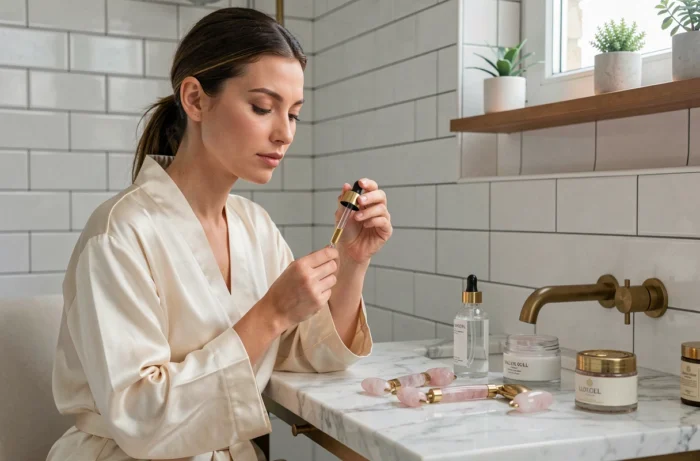
A reformulated waterproof mascara without any change to the packaging, a serum with marine actives whose texture has subtly evolved, a perfume whose capsules now contain different polymers: this season, beauty innovations are not just about marketing launches. Behind several products, there are reformulations imposed by new regulatory constraints that concretely change what we apply to our skin.
Ban on PFAS in cosmetics: what changes in your kit
Since January 1, 2026, French law n° 2025-188 prohibits the manufacture, import, and marketing of cosmetics containing PFAS. These perfluoroalkyl substances were used to ensure long-lasting wear and water-repellent effects in certain waterproof mascaras, foundations, and setting primers.
In practice, the long-wear formulas of several brands have been modified without the packaging always indicating the change. A product made before the law came into effect can still be found in stores. Therefore, the reformulation cannot be identified by the product name alone.
To check, consult the INCI list on the packaging or on the brand’s website. Compounds containing “fluor” in their name (PTFE, perfluorodecalin, polyperfluoromethylisopropyl ether) are the first indicators. If you find all the news on Babioles Beauté, the product sheets are regularly updated with the latest compositions.
This ban pushes laboratories to work on alternatives based on plant waxes and modified silicones. The textures are changing, sometimes for the better: several testers note less occlusive foundations and mascaras that come off more easily with warm water, while still maintaining decent wear throughout the day.
European restriction on microplastics: deadlines vary by product
The European regulation on synthetic polymer microparticles does not affect all categories at the same time. Rinse-off products (shower gels, shampoos, scrubs) are subject to a deadline in 2027. Rinse-free products (creams, serums, lotions) will follow in 2029. Lip and nail makeup products will only be targeted in 2035.
Fragrance capsules have a specific deadline, distinct from that of classic perfumes. The polymer microcapsules used for encapsulating fragrances in certain scented textiles and samples must be reformulated according to their own schedule.
This delay creates a situation where products from the same brand coexist on shelves with different formulations depending on their category. A shower gel may already be reformulated while the body lotion from the same range retains its old composition.
What this changes for face care and makeup
The pearlescent textures and shimmering effects of certain highlighters relied on plastic microparticles. Alternatives now use mineral powders (mica, silica) or cellulose derivatives. The result differs slightly: less mirror-like reflection, more diffuse brightness.
For serums and creams, polymer-based texture agents are being replaced by natural gelling agents. Textures are observed to be a bit less “slippery” to the touch, but skin penetration remains equivalent according to field feedback.
Fall makeup trends: finishes change register
Beyond regulatory constraints, this season’s launches are drawing a clear aesthetic direction. Modular makeup is gaining ground: palettes with interchangeable refills, multi-use sticks (lips, cheeks, eyelids), and adjustable tinted bases with pigment drops.
- Foundations are abandoning maximum coverage in favor of semi-transparent “second skin” finishes, more suitable for skin sensitized by care actives
- Liquid and gel blushes are gradually replacing compact powders, with textures that blend better on skin prepared by a serum
- Mascaras are focusing on brushes made from plant fibers rather than nylon, which changes the application technique (less effective zigzag movements, pressure application at the root is more suitable)
The application technique is as important as the formula. A mascara with a plant-based brush is not worked the same way as a classic mascara. You press the brush against the base of the lashes for two seconds before pulling upwards, rather than making multiple passes.
Skincare and serums: marine actives and fermented beauty are rising
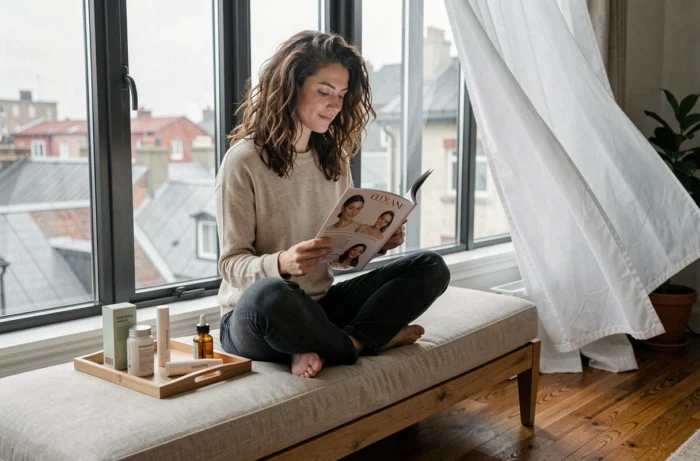
Serums with concentrated marine actives (brown algae, plankton extracts, marine thermal spring water) are multiplying in catalogs. French brands are exploiting coastal resources from Brittany and the Mediterranean to offer formulations based on local ingredients.
Fermented beauty, inspired by Korean cosmetics, is arriving in European ranges with a notable adaptation: ferments are combined with topical probiotics to strengthen the skin microbiome. Initial feedback indicates better tolerance in reactive skin, with less redness after two weeks of use.
Seasonal perfumes: drier and woodier notes
This autumn’s fragrance launches are leaning towards dry woody accords (vetiver, cedar, unsweetened sandalwood) mixed with resinous notes. We are moving away from the sweet gourmand scents that dominated previous seasons.
- Concentrated eaux de parfum are gradually replacing eaux de toilette in new launches, with extended wear without overdosing
- Rechargeable travel formats are becoming a standard among several houses, reducing the cost per milliliter in the long term
- Formulations are incorporating more certified natural extracts, which may slightly alter the scent from season to season depending on the harvests
The longevity of a perfume on the skin varies according to skin pH and hydration. Applying an unscented balm on pulse points before the perfume significantly extends wear, a field tip more effective than making multiple sprays.
The beauty trends of this season are reflected as much in the INCI compositions as in the visual campaigns. French regulations on PFAS and European restrictions on microplastics are reshaping the formulations available on the shelves. Before purchasing a new product, turning the bottle over remains the most reliable reflex.