Choosing an engine type, navigating low-emission zones that are reshaping urban traffic, and budgeting for maintenance costs all involve practical trade-offs from the moment you buy a car. This article compares the costs and restrictions associated with the main options available to French motorists today.
Car ownership costs: comparing petrol, electric and hybrid vehicles
The purchase price accounts for only a fraction of the true cost. Depreciation, routine maintenance, fuel or electricity, and insurance all contribute to the overall budget—one that few motorists calculate before signing on the dotted line. In practice, households switching from a petrol or diesel vehicle to an electric one spend significantly less on energy, since the cost of charging per kilometre is far lower than the cost of fuel.
| Cost | Petrol/diesel | Electric |
|---|---|---|
| Energy | High fuel costs, which vary with oil prices | Charging costs are significantly lower than fuel costs |
| Routine maintenance | Oil changes, filters, timing belt, clutch | No engine oil changes and fewer mechanical wear parts |
| Depreciation | Gradual and well documented on the used-car market | Depends on battery condition and is harder to estimate |
| Roadworthiness test | Mechanical components and pollutant emissions | Mechanical components and high-voltage system inspection |
This table highlights a structural difference: electric vehicles often cost more to buy, but their running costs are significantly lower. For a fair comparison, consider the total cost of ownership over the entire period you plan to keep the car, not just its list price.
Among the cars featured on Blog Automobile, detailed specifications make it easy to compare powertrains, vehicle classes and equipment to refine your calculations before making a commitment.

Low-emission zones and Crit’Air stickers: a technical factor in choosing a car
Low-emission zones (ZFE) change the equation for anyone buying a car for urban use. A common first step is to check the Crit’Air sticker category of the vehicle you are considering. That is not enough.
Restricted areas, operating hours and banned vehicle categories vary from one local authority to another. A Crit’Air 3 vehicle may be allowed to circulate freely in one city and banned in another. The official Service-Public website notes that there is no single rule that applies throughout France.
- Before buying, check the ZFE rules in the city or cities where you drive most often—not just where you live.
- Check for temporary exemptions: some local authorities allow grace periods or day passes for non-compliant vehicles.
- Plan ahead for changes to the timetable: several metropolitan areas intend to gradually tighten restrictions in the coming years.
This is a decisive factor for used-car buyers. A low-priced Crit’Air 4 diesel may be of little practical use if the local ZFE is set to exclude it in the near future. A vehicle’s true value also depends on whether you are allowed to drive it where you need to go.
Used electric-car batteries: the key check most guides overlook
Maintenance comparisons often highlight savings on oil changes and brake pads. They less often address the central issue when buying a used electric vehicle: the condition of the traction battery.
A degraded battery reduces real-world range and can be very expensive to replace. Before buying, it is wise to request a documented assessment, usually called a “battery health certificate” or “State of Health” (SOH) report. This assessment shows the remaining capacity compared with the battery’s original capacity.
Manufacturer and battery warranties: two different coverage periods
The vehicle warranty and battery warranty do not always cover the same period. Some manufacturers cover the battery for longer than the rest of the vehicle, while others offer the same coverage period for both. Check the battery warranty terms with the manufacturer before signing, especially the capacity threshold below which the warranty applies.
A used electric vehicle with high remaining battery capacity and an active warranty offers much better value for money than a newer model with no battery assessment.

Car maintenance and roadworthiness tests: keeping both schedules in sync
A roadworthiness test does not replace routine maintenance, but the two go hand in hand. A well-maintained vehicle passes its roadworthiness test without needing a retest in the vast majority of cases. By contrast, neglecting items such as faulty lights, worn tyres or low fluid levels can lead to a failed test—issues that could have been avoided with a simple check beforehand.
Roadworthiness tests also check pollutant emissions in petrol and diesel vehicles. Regular engine maintenance (oil changes, filters and spark plugs) directly helps keep emissions within the required limits.
Checks to carry out between roadworthiness tests
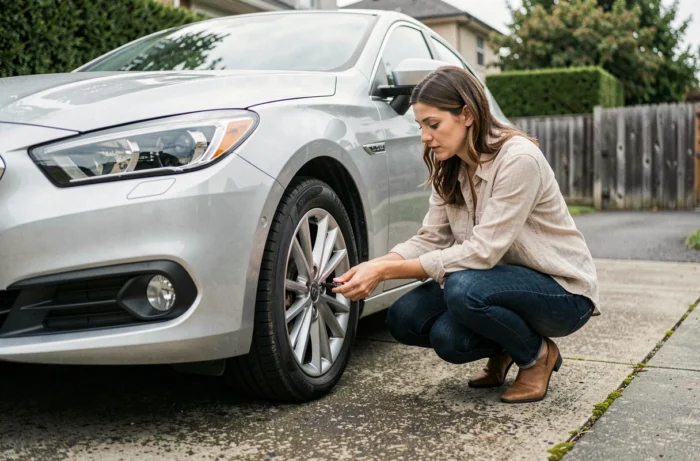
- Tyre condition and pressure: uneven wear may indicate a wheel alignment or suspension problem.
- Coolant, brake fluid and power steering fluid levels: an unusual drop between services warrants an inspection.
- Check that all lights work (headlights, brake lights, indicators and fog lights): two people can complete a visual check in under two minutes.
- Wiper blade and windscreen condition: a crack in the driver’s field of vision will result in a retest.
These checks require no tools or specialist mechanical skills. They help you catch the most common reasons for failing a test and avoid the extra cost of a retest.
Choosing a car, its powertrain and its maintenance schedule all form part of the same decision. An older diesel in a city with strict ZFE rules, a used electric vehicle with no battery assessment, or a vehicle whose maintenance is out of step with its roadworthiness test schedule can all lead to avoidable costs. Considering these three factors before you buy is still the best way to keep your motoring costs under control over the long term.