A 2-year-old who refuses everything, throws themselves on the floor, or bites for no apparent reason is going through a stage linked to the development of their emotional brain. At this age, the gap between their desire for independence and their ability to express their needs through language creates visible tension. Understanding this mechanism helps distinguish an expected developmental phase from a sign that warrants medical advice.
The emotional brain at age 2: what causes tantrums
The prefrontal cortex, the part of the brain responsible for impulse control and emotional regulation, is still very immature in a 2-year-old. In practical terms, the child feels emotions as intensely as an adult, but does not yet have the neural pathways to rein them in.
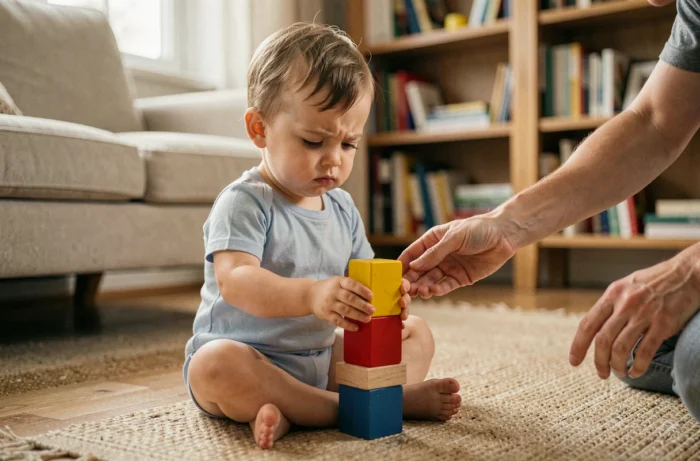
This gap explains why a minor frustration (a broken cookie, a door closed too quickly) can trigger a disproportionate reaction. The emotional brain responds before logical thinking has a chance to intervene.
At the same time, the child becomes aware that they are a separate individual from their parents. This discovery fuels a need for independence that constantly clashes with the limits imposed by their environment. Saying “no” to everything is not an act of defiance: it is the expression of a brand-new will that is still developing.
When considering abnormal behavior in 2-year-olds, this neurological foundation is the first thing to consider. Most behaviors that worry parents are due to this normal brain immaturity.
Typical behavior or warning sign: what to look for
Not all tantrums are the same. The distinction between a typical phase of defiance and a reason to seek advice depends on several specific factors that should be considered together, not in isolation.
What is part of expected development
- Intense but brief tantrums triggered by an identifiable frustration (being told no, a transition, tiredness), followed by a return to calm within a few minutes
- Frequent “no” responses, along with a desire to do things independently (eat, get dressed, choose)
- Difficulty with transitions, such as bedtime, leaving the house, or finishing an activity
- Alternating periods of calm and peaks of defiance, without a rigid pattern
When to seek medical advice
Regression in skills the child has already acquired is a sign to take seriously. If a child loses words they used regularly, stops responding to their name, or gives up social interactions they had mastered, this regression cannot be explained by a simple phase of defiance.
The intensity and duration of tantrums also matter. A child who repeatedly puts themselves in physical danger, whose tantrums never subside despite a consistent routine, or who displays highly repetitive behaviors (prolonged rocking, self-injury) should be assessed.
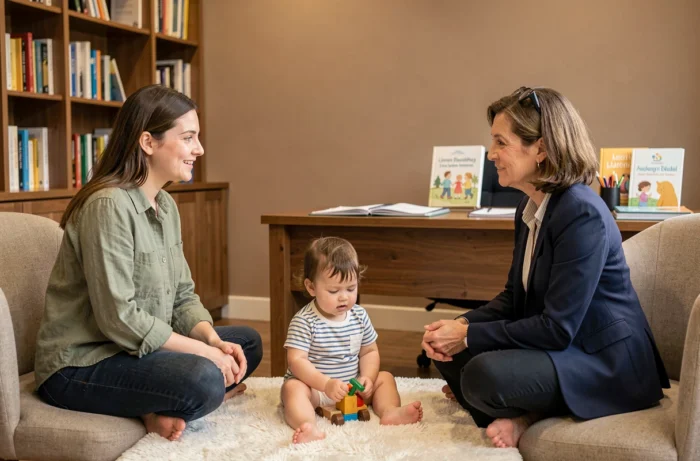
Parents’ instincts are a reliable guide. Persistent concern is always a reason to talk to a doctor, even if the behavior does not seem “serious” from the outside. The pediatrician assesses several areas of development (communication, understanding, play, interactions) to form an overall opinion.
Situational causes of unusual behavior at age 2
Before looking for a developmental explanation, consider the child’s circumstances. At age 2, behavior can act as an alarm signal for needs the child cannot yet put into words.
Disrupted sleep is the first situational cause to check. A child who sleeps poorly or not enough has a much lower tolerance for frustration. Tantrums become more frequent and intense even when nothing else has changed.
A change in routine (moving house, the birth of a sibling, starting daycare, parental separation) can lead to a surge in defiant behavior or temporary regression. The child expresses through their body what their limited vocabulary does not allow them to put into words.
Physical pain is often underestimated. Teething, a mild ear infection, or digestive discomfort may show up only as restlessness, biting, or unexplained crying. Noting exactly when the behavior occurs and what helps soothe the child can give the pediatrician useful clues.

Supporting a 2-year-old through a phase of defiance
Support is based on a simple principle: reduce unnecessary sources of frustration without removing boundaries. Children need both to develop a sense of security.
Offering limited choices (two options, no more) gives the child a sense of control without overwhelming them. “Do you want the blue pants or the gray ones?” works better than “Get dressed,” which requires a level of decision-making independence that is still too complex.
Naming the child’s emotion out loud (“You’re angry because you wanted to stay at the park”) helps them connect a word with a physical sensation. This link between language and emotion is precisely what, as vocabulary grows, reduces the frequency and intensity of tantrums.
Keeping routines predictable (consistent bedtime steps, departure rituals) reduces anxiety around transitions, which remain one of the most common triggers for tantrums at this age.
- Give advance warning before transitions (“Two more trips down the slide, then we’re going home”)
- Stay physically calm during a tantrum: get down to the child’s level, speak softly, and don’t try to reason with them at the height of their emotions
- Talk about what happened once the child has calmed down, using simple words to help them understand the situation
This phase of defiance usually lasts from a few months to just over a year, with varying intensity depending on the child and the circumstances. As language develops, it naturally helps ease the most intense behaviors.