
A pristine perennial bed, a neatly laid gravel path—and yet that strip of grass sticking out between the lawn and the border spoils the whole look. That’s exactly where a grass trimmer makes all the difference. Choosing the right model means identifying what you really need it to do: cut soft grass along a low wall, clear grasses that have overgrown around a fence post, or tackle tough regrowth along the edge of a flower bed.
Grass trimmer battery compatibility and lifespan
When choosing between two cordless models, we often compare their advertised runtimes. That makes sense, but it can obscure a factor that matters more in the long run: whether the battery can be replaced.
A lithium-ion battery pack gradually loses capacity after a few hundred charge cycles. If the battery is sealed in or unavailable as a spare part, the entire tool eventually ends up in landfill.
From February 18, 2027, the European Batteries Regulation will require certain integrated portable batteries to be removable and replaceable, and to be available as spare parts for a minimum period. This rule does not automatically cover every grass trimmer (exceptions apply for safety reasons), but it is encouraging manufacturers to design more repairable products.
Before buying, check two things: can the battery be removed without a special tool, and does the manufacturer offer a compatible battery pack for other tools in its range (leaf blower, hedge trimmer, chainsaw)? Using the same battery format across several tools reduces the overall cost and avoids accumulating chargers.
Conversely, a tool sold “bare” (without a battery) may seem inexpensive, but buying the battery and charger separately can sometimes cost more than the tool itself. To compare offers and compatible battery systems, visit taille-bordure-warrior.com, which brings together detailed product specifications by model.
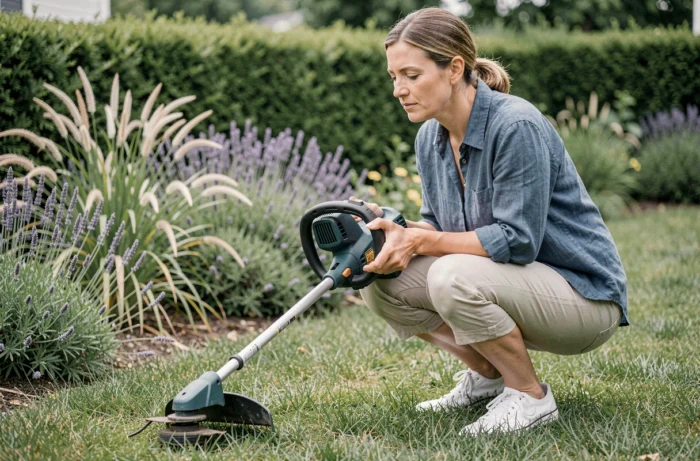
Cutting width and line type for different terrain
Cutting width determines how quickly you can work, but also how easy the trimmer is to handle in tight spaces. In an urban garden with closely spaced flower beds, furniture legs and curved borders, a wide cutting head can be cumbersome. A moderate cutting width offers greater precision.
By contrast, on a plot of several hundred square metres with long, straight borders, a generous cutting width reduces the number of passes and the time spent outdoors.
Round line, serrated line or plastic blades
Cutting systems vary from one model to another, and the right choice depends on what you actually need to trim.
- Standard round line is suitable for soft grass and neat finishing along a lawn that is mowed every week. It wears quickly on dry grasses and woody weeds.
- Serrated line (square or star-shaped) cuts more effectively through thick grass and tough regrowth. It’s a good choice if the border runs along an embankment or a semi-wild area.
- Rotating plastic blades replace the line on some entry-level models. Their advantage: there’s no spool to refill. Their drawback: they break on the slightest pebble, and their cutting diameter remains limited.
Line diameter also matters. Thin line cuts young grass cleanly, while thicker line stands up better to tough stems. Checking the maximum line diameter accepted by the cutting head before you buy helps ensure you don’t end up with an unsuitable consumable.
Grass trimmer weight and ergonomics: what really affects comfort
On paper, a difference of a few hundred grams between two models seems insignificant. In practice, after twenty minutes of working with your arms outstretched along a fence, you’ll feel it in your shoulder and wrist. The total weight when ready to use (with a fully charged battery, not empty) is the only figure that matters.
Three ergonomic features make a real difference to comfort:
- An adjustable auxiliary handle lets you adapt your grip to your height. Without one, you have to bend over to compensate, which strains your back.
- A telescopic shaft lets you adjust the tool’s length. With a fixed shaft, taller users have to work hunched over.
- An adjustable head (pivoting 90 degrees or more) turns the grass trimmer into a vertical edging tool, letting you create a clean edge along a path without changing position.
This last point is often underestimated. Without a pivoting head, you have to tilt the entire tool to cut vertically. The movement is less precise and more tiring, and the result looks more like a scalped edge than a neat finish.
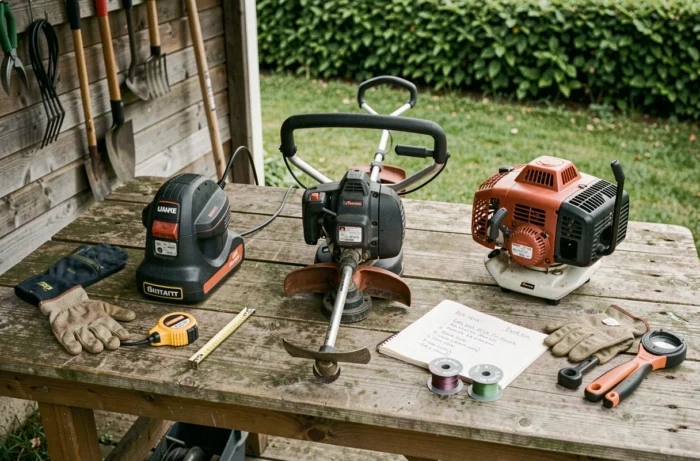
Corded electric, battery-powered or petrol: which grass trimmer is right for your garden?
The power source determines freedom of movement and available power. Each option has a primary use case.
A corded electric model is still the lightest and least expensive to buy. It runs at full power as long as it’s plugged in, with no need to worry about runtime. Its obvious drawback: the cable limits your range and creates a risk of accidental cuts when trimming along thorny flower beds or metal fences. It’s suitable for small urban gardens.
A battery-powered grass trimmer gives you complete freedom of movement. Runtime varies depending on the battery pack’s capacity and the density of the vegetation being cut. In thick grass, actual runtime drops significantly compared with figures advertised under ideal conditions. Bear this in mind if your garden includes overgrown areas.
A petrol model delivers the most power. It’s suited to large plots, slopes and tall grass. Its greater weight, noise, vibration and engine maintenance (spark plug, filter, fuel mix) make it a tool for users who genuinely need that level of performance. For a standard garden of a few hundred square metres, a petrol model is overkill.
The choice comes down to the size of your garden and the type of vegetation. A small urban garden with soft grass calls for a corded model or an entry-level battery-powered trimmer. A larger plot with varied borders (low walls, wire fences, embankments) calls for a more powerful battery model or, in extreme cases, a petrol trimmer. Matching the power to your actual needs avoids paying extra for weight, noise and maintenance on a tool with capabilities you’ll never use.