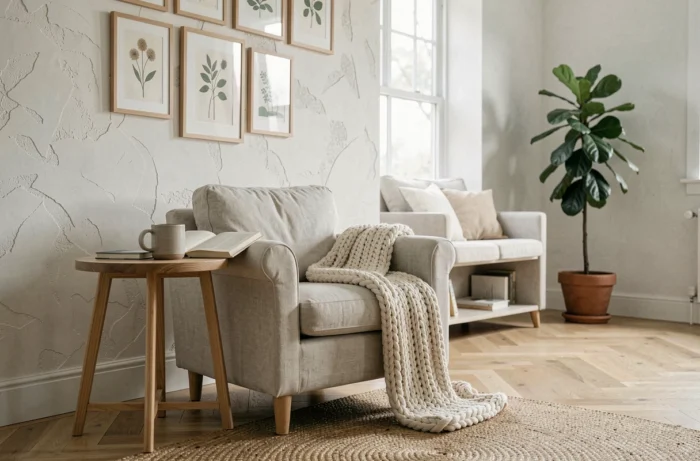
Transforming an interior has less to do with budget than with prioritizing your choices. Colors, materials and furniture layout all interact with a room’s proportions and natural light. Interior design feels more cohesive when you tackle the surfaces (walls and floors) before adding furniture or accessories.
Paint VOC labels: an often-overlooked interior design factor
Choosing a wall color starts with the shade, but you should also check the label. Since 2013, relevant construction and decorating products sold in France have been required to carry a VOC emissions label, rated from A+ to C. A paint rated A+ emits the fewest volatile organic compounds, making it the baseline choice for a healthier interior.
An A+ rating alone does not guarantee good air quality. Ventilation, application conditions and interactions with other materials in the room matter just as much. Applying two coats of A+ paint in a closed living room without ventilating while it dries cancels out some of the benefits.
In practice, when browsing interior design ideas on French Home, keep in mind that how a shade looks also depends on the surface it is applied to and its composition. Matte paint does a better job of hiding imperfections on an old wall, but low-end matte formulas may contain more mineral fillers that affect their durability over time.
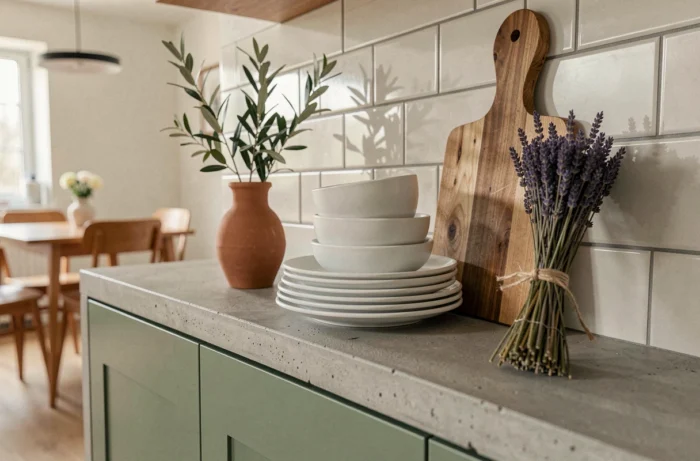
Secondhand furniture: choose for repairability, not just style
Reusing furniture is no longer just about browsing flea markets. ADEME reports growth in reuse and repurposing in France, driven by extended producer responsibility (EPR) schemes. Reuse centers, social and solidarity economy organizations, specialist platforms: the options are multiplying.
The usual approach is to look for a piece that matches your chosen style (industrial, Scandinavian, vintage). A more useful criterion for an interior that is likely to evolve is the furniture’s ease of disassembly and repair. A solid wood table with a bolted base can be taken apart, transported and repaired. A table made from glued particleboard can only be assembled once.
- Choose mechanical joints (screws, bolts, dowels) over glued joints, which do not withstand disassembly.
- Check the condition of the hardware (hinges, drawer runners): these are the first parts to fail, and they are easy to replace if the furniture is well designed.
- Hardwood species (oak, beech, ash) can be sanded and refinished, making it possible to completely change a piece’s appearance without replacing it.
To incorporate secondhand furniture into a cohesive interior design scheme, limit the room to two or three visual styles. A 1960s sideboard works alongside a contemporary table if they share a material, such as light wood or black metal.
Living room colors and proportions: work in layers
Don’t choose a color from a swatch—test it on the wall in the room’s natural light. A gray-green that looks soft on a sample can turn khaki in a north-facing living room. Always test a patch of at least one square meter before making your final choice.
The most reliable way to transform a living room without redoing everything is to work through the layers in order: walls, floor, large furniture, textiles, accessories. Each layer has a different visual impact.
Walls and ceiling: the first step in transforming a room
An accent wall (a single wall painted in a bold shade) changes how deep a room appears. In a long living room, painting the far wall a darker color makes it seem closer and helps balance the proportions. A white ceiling is the safest choice for keeping the room feeling spacious, except in rooms with high ceilings, where a light shade (linen, sand) adds warmth.
Floor and textiles: grounding the space
A large rug under the sofa and coffee table visually brings the living room together better than several small rugs scattered around. As a rule of thumb, the rug should extend at least twenty centimeters beyond each side of the sofa to define the area.
Textiles (curtains, cushions, throws) are the easiest and least expensive layer to change from season to season. Stick to neutral tones for the sofa and curtains, and save bright colors or patterns for cushions and accessories.
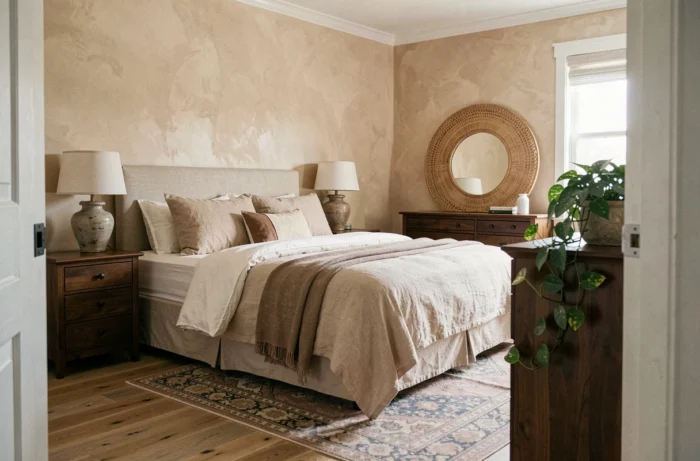
Houseplants and light: two connected factors
Adding plants without considering the available light can lead to two problems: plants that struggle to thrive, or plants that take up too much space near the only window. Mapping out the bright areas before choosing plant varieties helps avoid both.
A north-facing room with little direct light suits pothos, snake plants or ZZ plants. A sun-filled south-facing living room can accommodate ficus trees, indoor olive trees or bird of paradise plants. A plant’s mature size matters just as much as its light requirements: a fiddle-leaf fig can easily reach two meters and take over an entire corner.
Planters also contribute to a cohesive look. An unglazed terracotta pot fits naturally into an interior with natural materials such as wood, linen and rattan. A glazed ceramic pot works better in a more streamlined space. Limiting planters to two materials per room helps prevent a cluttered look.
Artificial lighting completes the setup. Using multiple light sources (a table lamp, wall light and pendant) instead of relying on a single central ceiling light lets you adjust the mood to suit the activity: reading, dining or relaxing. A color temperature of around 2700 K creates warm light suited to living spaces.
We find that most interiors gain character not by adding objects, but by removing those that serve neither a practical purpose nor the eye. A cleared wall, a piece of furniture removed, an uncluttered countertop: empty space is just as much a part of interior design as the things that fill it.