
Buying a reliable used car often starts with a simple question: what do I really need day to day? But that question hides another, less obvious one. The price listed in the ad represents only a fraction of what the vehicle will cost over three or five years. Routine maintenance, insurance, wear-and-tear parts, local driving restrictions: these hidden expenses can turn an apparent bargain into a money pit. Here’s how to approach the decision methodically.
The true cost of owning a used car over several years
You’ve spotted a diesel sedan at an attractive price. The mileage seems reasonable, and the exterior is in decent condition. Before you sign, grab a pen and do a calculation few buyers make: the total cost of ownership over three to five years.
This calculation includes several items. First, insurance, which varies considerably depending on the engine, the vehicle’s age, and your driver profile. A ten-year-old diesel SUV often costs more to insure than a recent petrol city car with equivalent coverage.
Routine maintenance also adds up. If the timing belt needs replacing in the months after purchase, that could add several hundred euros to the bill. Check the service book to see whether this work has already been done. If the service book is incomplete or missing, assume that major servicing is due.

Also consider local restrictions. In several urban areas, low-emission zones (LEZs) are gradually banning certain vehicles based on their Crit’Air sticker. Even a mechanically reliable older diesel may become unusable for your commute. Check the Crit’Air sticker before committing, especially if you drive in an urban area.
To compare several listings effectively, browse the cars from Ct Automobiles and compare the technical specifications and prices of different models.
Engine type and mileage: two factors that depend on how you drive
Do you drive fewer than 15,000 kilometres a year, mostly in town? A petrol or hybrid engine will suit you better than a diesel. Diesel engines are designed for steady speeds over long distances. In urban driving, their particulate filters can clog, leading to costly breakdowns.
On the other hand, if you cover long motorway distances every week, a well-maintained diesel with high but consistent mileage can still be a sensible choice. High motorway mileage causes less wear than average mileage in town. Cold starts, frequent braking, and working the clutch in traffic put much more strain on mechanical components.
For mixed driving, hybrid engines offer an appealing compromise. Maintenance costs remain manageable: brake pads, for example, last longer thanks to regenerative braking. Bear in mind that a hybrid battery has a limited lifespan. When buying a used model, ask about its condition and the cost of replacement.
Mechanical and administrative checks before buying
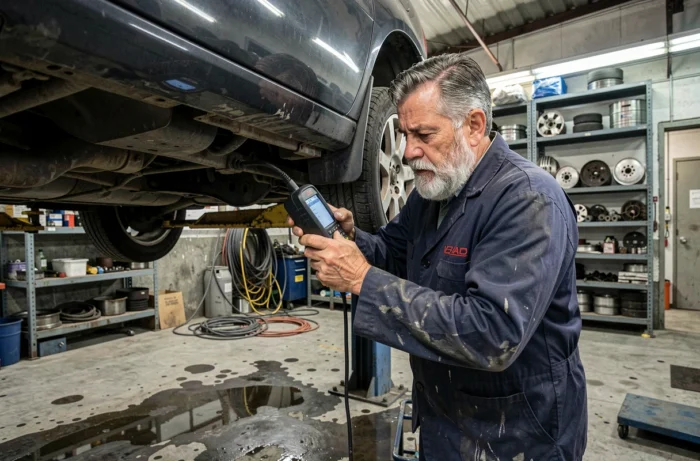
You’re not a mechanic? That’s not a problem, as long as you know what to look for. During the test drive, watch out for a few telltale signs:
- Vibrations in the steering wheel at a steady speed often point to unbalanced wheels or unevenly worn tyres, which could be masking a wheel alignment issue
- A metallic noise when going over speed bumps may indicate worn-out shock absorbers, a replacement job that can quickly become expensive
- Persistent white smoke from the exhaust, even when the engine is warm, points to a head gasket problem—a costly repair best avoided
- A clutch that “slips” uphill (the engine revs rise without the car accelerating) means it will likely need replacing soon
Always ask to see the service book and the latest roadworthiness test report. The report lists any faults found. A seller who refuses to show it or keeps postponing the inspection should raise a red flag.
On the administrative side, check that the vehicle registration certificate (carte grise) is in the seller’s name. A vehicle being sold by someone who is not listed as its registered owner could indicate a scam or that the vehicle is subject to a lien. You can check for free whether a vehicle has a lien or other restriction through the official Ministry of the Interior website.
Warranty and buying from a dealer or a private seller
Buying from a dealer generally costs a little more than buying privately. Part of the difference is explained by the legal guarantee of conformity, which covers non-obvious defects for a minimum period after purchase. When buying from a private seller, only the warranty against hidden defects applies, and the buyer must prove that the defect existed before the sale.
In practice, this difference matters a great deal if a mechanical problem arises in the first few months. If an engine fails three weeks after you buy from a dealer, it will be covered. With a private seller, you’ll have to pursue a lengthy and uncertain claim.
For first-time buyers or those without a trusted mechanic, buying from a professional significantly reduces the financial risk. The slightly higher price acts as insurance against unpleasant surprises.
One last point that’s often overlooked: don’t rush into a purchase. A seller who is in a hurry to close the deal, insists on a quick decision, offers a price well below market value, or refuses a test drive is sending clear warning signs. The right used car is out there; it’s simply worth taking the time to carry out a few checks.