
The Belgian property market is entering a phase in which prices continue to rise while transaction volumes decline. This divergence, visible since the third quarter of 2026, is reshaping the choices made by buyers and investors. Understanding where momentum differs between regions, property types and tax profiles makes it easier to assess the months ahead.
Transactions and prices in Belgium: diverging trends
The Notaries Barometer indicates that property sales fell in the third quarter of 2026 compared with the record levels recorded in 2025. Wallonia, where sales volumes had surged by 16.7% over the previous year, and Flanders, buoyed by the reduction in registration duties, are both seeing this momentum ease.
Average prices, however, continue to rise. The Belgian notarial profession confirms that average prices increased in the same third quarter. The market is showing a classic pattern of slowing transaction volumes without a price correction, pointing to a tightening supply of available properties rather than a loss of interest among buyers.
| Indicator | 2025 | Q3 2026 |
|---|---|---|
| Sales volume (Wallonia) | Up 16.7% vs 2024 | Decline recorded |
| Sales volume (Flanders) | Record level | Decline recorded |
| Average prices (Belgium) | Rising | Still rising |
| Property tax | Reference point | Up 2.5% (cadastral income indexation) |
To track these indicators in real time, Immosphère news regularly compiles Belgian market data by region and property type.

Energy renovation: the factor widening the price gap between properties
The price gap between renovated homes and properties requiring work is widening, particularly in Brussels. Immoweb reports a growing share of Brussels homes listed for sale with renovation work needed, priced significantly below properties in good energy condition.
This discount is not due solely to the condition of the building. It also reflects the anticipated cost of renovation requirements. The least energy-efficient homes will have to meet a minimum energy-performance threshold by 2033 in Brussels, requiring future buyers to budget for renovations from the outset.
Regional support schemes: varied and subject to change
Funding for these renovations varies by region, and support schemes are changing rapidly.
- In Wallonia, the government plans to introduce a subsidised loan scheme, with funding announced for 2027 and a second phase starting in 2028. The timeline remains subject to budget decisions.
- In Flanders, the expansion of the Mijn VerbouwLening programme aims to cover work in the communal areas of apartment buildings (roof and façade insulation, window replacement and shared energy systems).
- In Brussels, new rental standards are already in force, increasing pressure on landlords with energy-inefficient properties.
The ability to finance renovations now weighs as heavily as the purchase price when calculating the profitability of a rental investment.
Property taxes in 2026: what is increasing owners’ costs
Three tax mechanisms are weighing on property owners simultaneously this year.
The first is the indexation of cadastral income, which leads to a 2.5% increase in property tax before municipal surcharges are applied. For owners of multiple properties, the cumulative effect across several homes is becoming significant.
The second concerns tax returns. New reporting requirements apply to income from properties held abroad or rented out through a company, making administration more complex for diversified investors.
The third relates to VAT on energy equipment. The recently introduced VAT reduction on heat pumps lowers installation costs. However, it does not offset the announced removal of certain renovation grants in Flanders, reducing overall support for Flemish homeowners undertaking renovations.
Buying property in Brussels: the move to the outskirts gathers pace
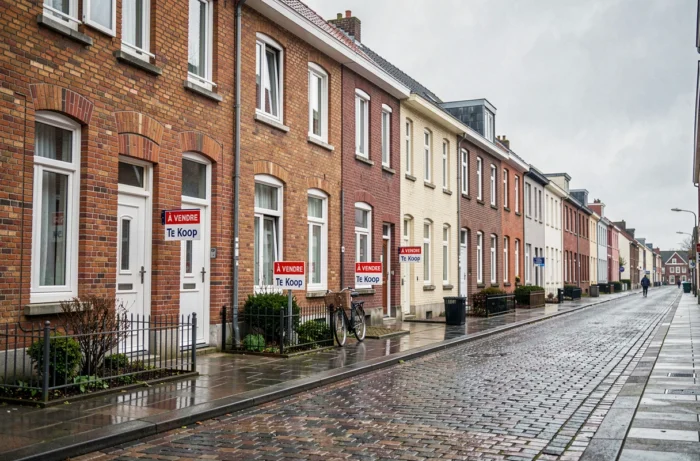
Data from Levier.be shows that a growing number of Brussels residents are buying outside the Brussels-Capital Region. Several factors are driving this trend: registration duties that remain higher in Brussels than in Flanders, an ageing housing stock requiring substantial investment, and per-square-metre prices that make detached houses almost unaffordable in the 19 municipalities.
A house in need of renovation in the Flemish outskirts is becoming the typical choice for first-time buyers from Brussels. The difference in registration duties between regions is accelerating this residential shift.
This trend has a direct impact on the Brussels market: the share of apartments in the housing stock continues to grow, with more than six in ten homes in Brussels already being apartments. Brussels townhouses coming onto the market are increasingly likely to need renovation, further deepening the discount associated with energy performance.
The Belgian market in 2026 can be understood through two lenses: geography (regional differences are widening) and energy (the EPC rating is becoming as important to property prices as location). Buyers who factor the total cost—purchase, renovation and taxes—into their calculations from the outset are best placed to identify the real sources of value in this changing market.