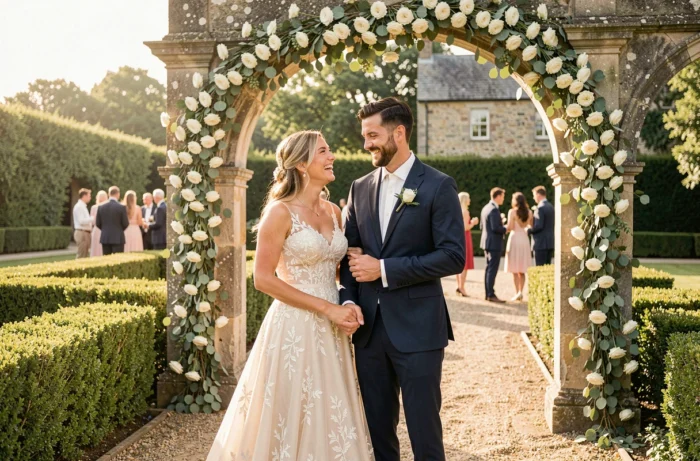
A couple hosting 80 guests at a remote country estate with no return shuttle arranged discovers at midnight that half their guests are looking for a taxi. This kind of logistical detail, rarely glamorous, can turn a successful day into a difficult evening. Planning an unforgettable wedding starts here: with the practical constraints you anticipate before choosing the flowers or the playlist.
Venue accessibility and guest transportation
We often think about the setting, the capacity and the character of the stone walls. But the first thing to consider when choosing a reception venue is how your guests will get home after midnight.
An estate 40 minutes from the nearest train station can be a real problem if some of your guests are coming without a car. Comparing travel times from the train station or airport, checking whether accommodation is available nearby and arranging a return shuttle can matter just as much as the venue’s charm.
Couples expecting guests from out of town can include a detailed directions guide with their invitations, covering carpooling options, nearby hotels and shuttle times. You can also find useful resources on the Mon Plus Beau Mariage website to help plan this often-overlooked logistical step.
If the venue has limited parking, it’s best to find out during your site visit. Asking the owners about parking helps avoid last-minute improvisation on the big day.

Wedding budget: decide on your guest count before booking
Wedding budgets often run over. The most direct way to stay in control is to keep your guest list in check. Every additional guest affects the catering, furniture rental, tableware, drinks and sometimes even the choice of venue.
Instead of setting an overall budget and then dividing it into categories, you can reverse the process: first identify your three top priorities (the venue, caterer and photographer, for example), then adjust the guest count to fit the remaining budget.
Key expenses to prioritize
- The reception venue, which is often the biggest expense and determines the date, capacity and style of the day
- The caterer, whose prices vary considerably depending on the format (sit-down meal, cocktail reception with substantial bites, food trucks), with per-guest costs ranging from one to three times as much
- The photographer and videographer, whose work is the only service that lasts for years after the ceremony—and where cutting corners on quality will be noticeable for a long time
Other expenses (floral decorations, stationery, entertainment) are easier to adjust. Setting your three budget priorities before booking anything helps prevent a domino effect, where each expense eats into the budget for the next.
Weather backup plan: turn a constraint into a design choice
Planning an outdoor ceremony without a backup plan means betting on the weather. And in some regions, heat or wind can be just as challenging as rain.
A photographer working in the Alpilles explains how the mistral changes the pace of photo sessions, shifts lightweight setups and tires out guests exposed to the elements. Their advice: identify sheltered areas at the venue in advance, not as a last-resort fallback, but as an indoor setting prepared with the same care as the outdoor space.
In practice, visiting the venue in bad weather reveals things that promotional photos never show. You can identify shaded areas, backup rooms and routes between indoor and outdoor spaces. A well-lit interior, with a few carefully planned decorative touches, can produce photos just as beautiful as a sunset on the terrace.
Symbolic ceremony and civil wedding: what the law actually requires
Symbolic ceremonies have become increasingly popular in recent years, and many couples see them as the highlight of their wedding day. One thing to keep in mind: a symbolic ceremony has no legal standing in France. It does not replace the civil ceremony at the town hall.
A civil wedding is still the only marriage recognized by law. It requires an application to be prepared several weeks before the date, including the names of your witnesses and proof of address.
How to fit both ceremonies into your day
Some couples have their civil ceremony in the morning and their symbolic ceremony in the afternoon at the reception venue. Others choose to get married at the town hall a few days earlier, leaving the wedding day free to focus on a personalized celebration.
The choice depends on the distance between the town hall and the reception venue, how many guests will attend both ceremonies and the pace you want for the day. In any case, checking available time slots at the town hall as soon as you start planning is a step you shouldn’t put off.
Wedding vendors: book in the right order
The order in which you book your vendors matters. The venue determines the date. The date determines whether the caterer, photographer and DJ are available. Book in the wrong order, and you may have to change your date or give up a key vendor.
Here’s the booking sequence that works in practice:
- Book the reception venue first, as availability is the biggest constraint; some venues are booked more than a year in advance
- Book the caterer second, because some venues require you to use a preferred caterer or have on-site kitchen restrictions
- Book the photographer and symbolic ceremony officiant third, followed by musicians and the decorator
- Order stationery and invitations once the date, venue and theme are finalized to avoid having them reprinted
Before signing, always check the cancellation terms and required deposits. A clear contract protects both parties, especially when bookings are made more than a year in advance.
What sets a well-organized wedding apart from a stressful one is nothing spectacular. It’s having the logistics, contracts and backup plans in place before moving on to the fun choices: decorations, music and surprises for your guests. When the foundations are solid, there’s plenty of room for emotion.